


A landscape that can look empty
On the margin of the Fergana Basin in south western Kyrgyzstan, canals, fields and enclosed homesteads are still legible in the landscape. At first sight it is a dry setting below the Shadymyr Mountains. For farming, however, the decisive resource is available only briefly: water from spring snowmelt and seasonal surface runoff.
More than 25 kilometres of canals
Research at Ravat documented more than 25 km of irrigation canals, over 90 fields covering about 60 ha and 45 homestead or settlement enclosures. The canals form a hierarchy of primary, secondary and feeder branches. This is not a group of isolated plots, but infrastructure connecting a large part of the agricultural landscape.
Households farmed separately, but water connected them
Individual households could cultivate their own plots and make decisions about daily land management. Water could not be managed within a single homestead. It had to move through the network, and its distribution required coordination among several users. Ravat therefore distinguishes shared infrastructure from a centrally managed economy. A common system does not automatically imply a single political or administrative authority.
Soil adds what the canal map cannot show
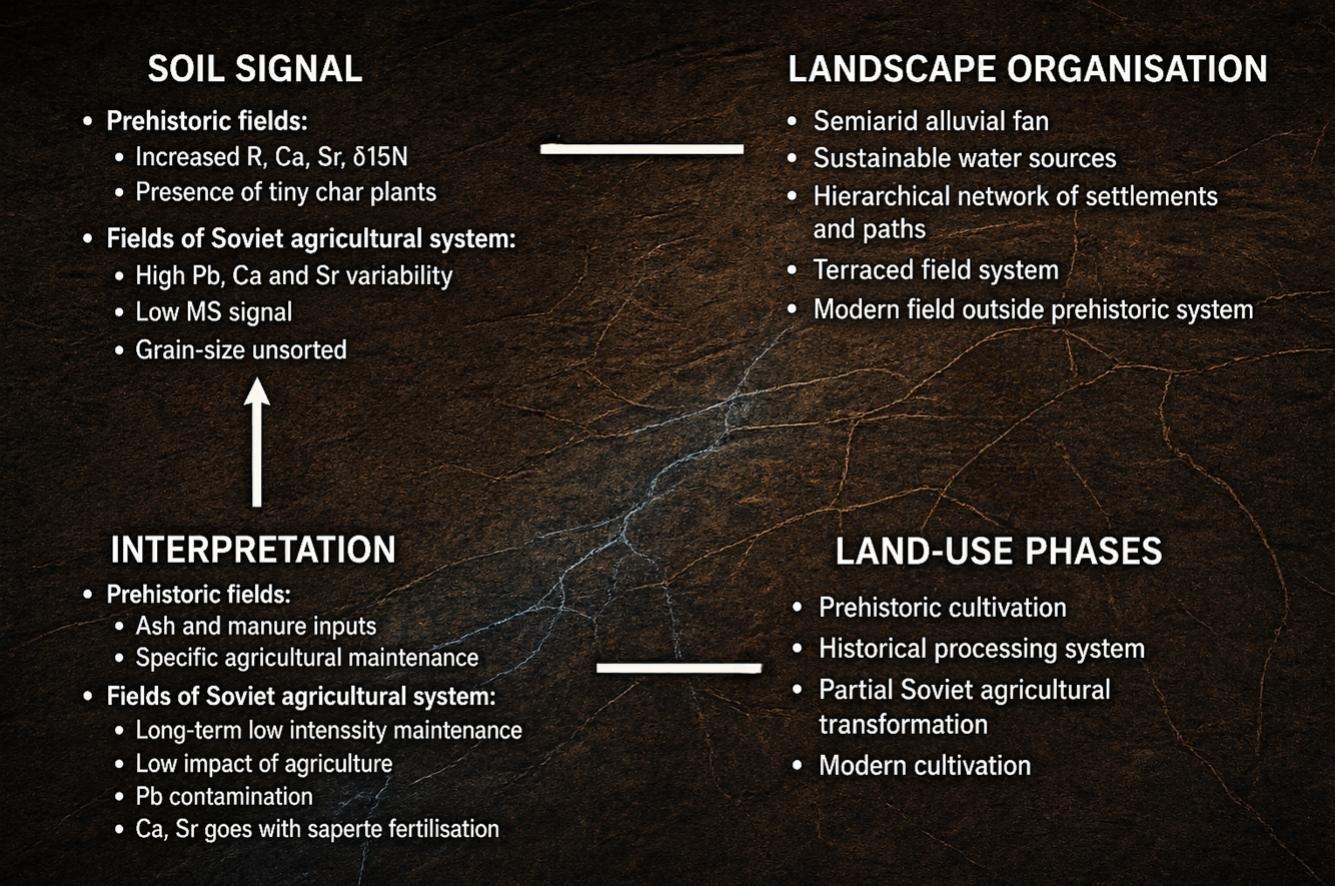
The spatial layout shows where water moved. Geochemistry and stable isotopes add evidence for what happened on the fields over longer periods. Prehistoric soils differ from Soviet period and modern fields and preserve evidence of long term organic fertilisation. Higher δ¹⁵N values support inputs of manure or animal excrement, although they do not identify one specific management practice on their own.
Not a simple rise and collapse
The evidence also records later use and reorganisation of parts of the system. Some fields contain different plant inputs and radiocarbon evidence documents later activity. The result is therefore not a simple story of a canal system being built and then suddenly abandoned. It is a landscape whose infrastructure was modified, reused and adapted to new conditions.
What Ravat changes
Ravat shows that social organisation cannot be read only from monumental architecture. Ordinary infrastructure can be more revealing. Fields may be associated with individual households, but water creates relationships that cross their boundaries. Soil, in turn, preserves everyday practices that architecture may never record.
← All HEL Stories